Map the system first.
Agents propose the rebuild. You approve it.
Agentic coding is making custom UIs and headless front-ends cheap to build on top of Dataverse. What makes that safe is a control chain. Pathix is read-only and never writes to your environment, and through one MCP it hands any agent a deterministic account of how the current system behaves. The agent proposes the rebuild from that, and every change stays yours to approve.
Your structure lives in compiled plugins, not in your data.
AI agents handle a lot of Dynamics questions well. They read your data, run queries, summarize records. But what writes a column, or what a plugin does, does not live in the data. It lives in compiled plugin code, workflow XAML and flow JSON, the blobs Dataverse can hand an agent but cannot interpret. So the agent guesses, or tells you it cannot see. Pathix parses all of it once per scan and exposes the result as an MCP server.
The whole graph, callable by any agent.
Point Claude Desktop, Copilot, Cursor, or your own orchestration at your Pathix deployment and it answers dependency, security, and inventory questions natively, with structured confidence in every response and no SQL required of the agent. Same scan, same graph, the same deterministic answer, not a natural-language guess over your data. 22 typed tools:
The dependencies static analysis can't prove alone.
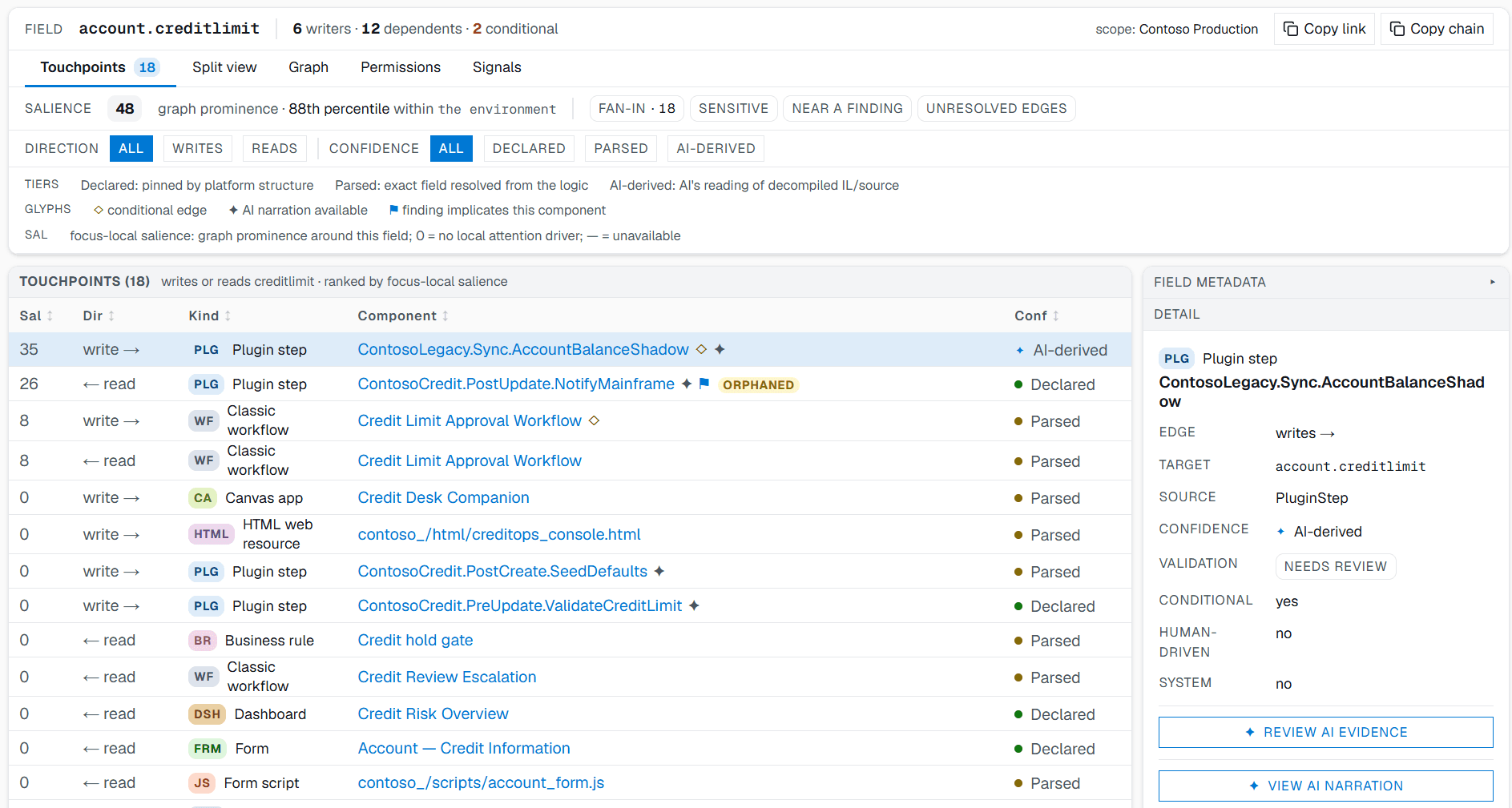
What the deterministic walker cannot prove from the IL, an optional AI sweep proposes as a candidate edge: labeled AI-derived, coupled to its evidence, and net-new. It never overrides a proven edge, and every one is a click from its citation. Dynamic and late-bound writes get caught this way, and stay separable from what was proven.
Every plugin, workflow, and flow, in plain English.
Point the optional narration at a component and Pathix decompiles it and explains what it does: its trigger, its logic, the exact columns it writes and reads. Each narration shows the model that produced it and a confidence tier, and it is built to be confirmed in review, not taken on faith.
The plan an agent built from the graph, yours to judge.
Both came out of the cold run with no plan and junior-developer prompting, raw and unedited: the full migration plan, and a developer work-item spreadsheet ready to hand a build team. The plan caught that five of six plugins silently swallow their errors, so the production rollups may already be wrong, and its instruction is blunt: recompute on migrate, do not trust-migrate.
The migration plan
The cold run's deliverable, raw: executive summary, the four-table target schema, full column and plugin disposition, a five-phase reversible sequence, and the data-integrity caveat called out up front.
The developer work tracker
The same plan as a spreadsheet you could hand a build team: every column and plugin as a row with its disposition, target table, notes, and a migration-status column to work to done.
Built from a live Pathix scan of a synthetic demo environment, all six plugins decompiled at High confidence. Behavioral narration is a reading of decompiled code that the plan says to confirm against source before retiring a step. The agent produced a plan, not an execution.
Bring your own AI provider, inside your own boundary.
Choose Azure OpenAI, OpenAI, or Anthropic, so you are not tied to one AI vendor. Your key is stored encrypted in Key Vault and never logged, and you opt environments into summarization one at a time. AI is off by default. For sovereign and government deployments, bind AI to a provider inside your boundary such as Azure OpenAI Service in Azure Government. The exact configuration and impact level are scoped per engagement.
The headless wave is coming to Dynamics. You'll need ground truth to ride it.
As agentic coding makes custom front-ends cheap, more teams will run Dataverse headless with agent-built UIs on top. The risk is that an agent rebuilding your environment cannot see the logic and security model buried in the current one. Understanding the system as it is built has to come first, and that is the part Pathix does today.
Optional, in your tenant, never the source of truth.
Off by default
Every AI feature is opt-in. The deterministic core works at full fidelity with zero AI.
Bring your own key
AI runs on your own Azure OpenAI, OpenAI, or Anthropic key, in your tenant. The vendor never proxies, brokers, or sees the traffic.
Never overrides facts
AI-derived edges are labeled, evidence-coupled, and net-new only. They never override or upgrade a deterministic result.
Confirm before you rely
Narrated behavior is a high-quality reading of decompiled code, labeled with the model and a confidence tier, meant to be confirmed in review.
Point your agent at a real environment.
A 30-minute walkthrough on a pre-scanned demo environment, with the Pathix MCP live.