AI is optional.
With Pathix, it stops guessing.
The deterministic core of Pathix uses no AI and is the source of truth. AI is opt-in, on your own key, in your own tenant. Turn it on and an agent reads decompiled plugin behavior, catches the edges static analysis can't prove alone, and answers questions through the Pathix MCP that nothing else can. That is Pathix's AI. The AI your makers built, the Copilot Studio agents, AI Builder models and prompt columns on the environment, is a subject of the graph rather than a tool of it, and has its own page.
The dependencies static analysis can't prove alone.
Pathix's deterministic walker proves the dependencies it can from the IL, XAML, and flow JSON. What it can't prove deterministically, an optional AI sweep proposes as a candidate edge: labeled AI-derived, coupled to its evidence, and net-new. It never overrides a proven edge, and every one is a click from Review AI Evidence.
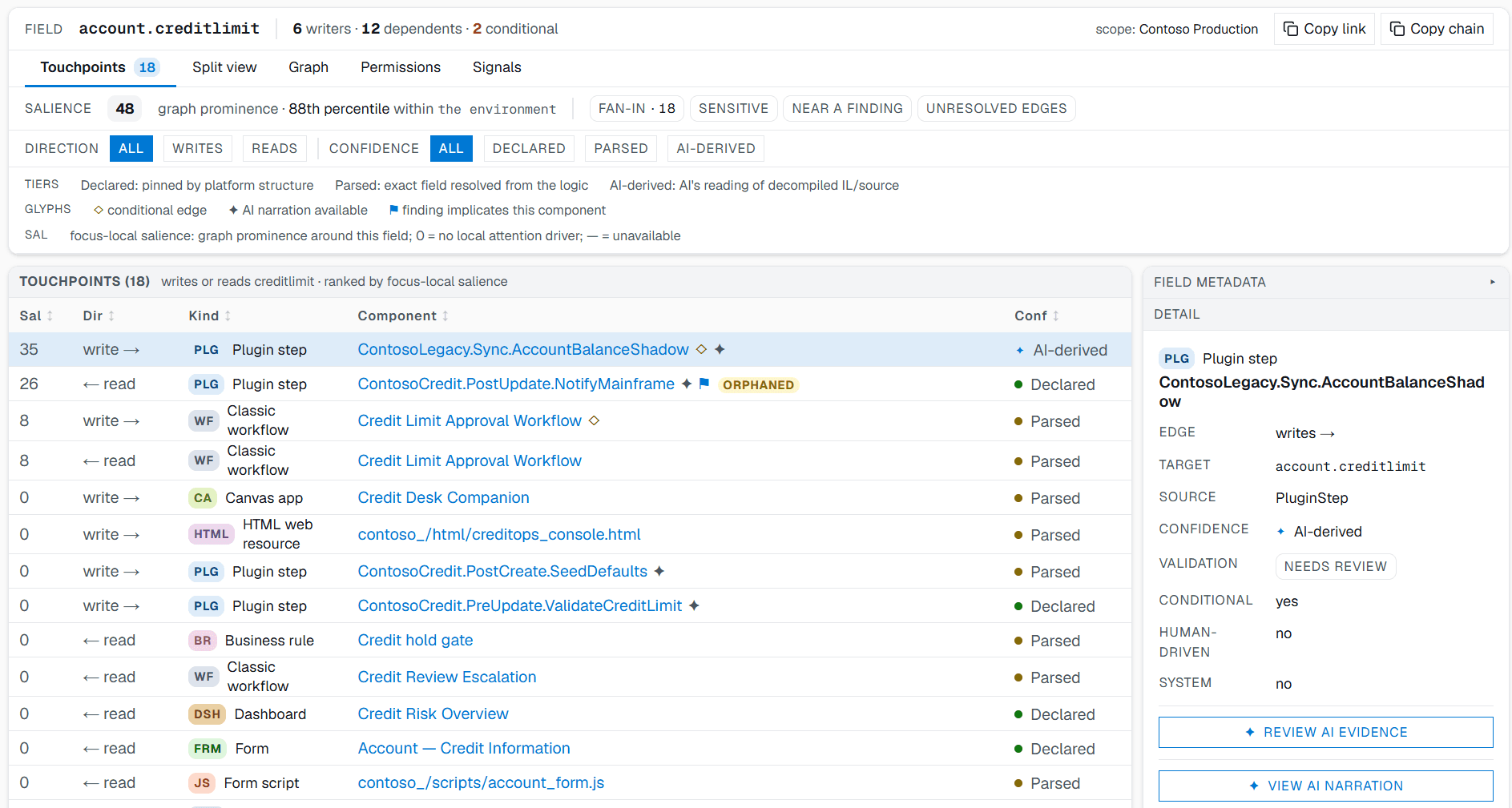
Every plugin, workflow, and flow, in plain English.
Point the optional narration at a component and Pathix decompiles it and explains what it does: its trigger, its logic, the exact columns it writes and reads. Each narration shows the model that produced it and a confidence label, and it is built to be confirmed in review, not taken on faith.
Which component types get narrated, and why the list stops there →
The whole graph, callable by any agent.
Pathix parses your environment once per scan and exposes the result as an MCP server. Point Claude Desktop, Copilot, Cursor, or a custom orchestration at it and it answers dependency, security, and inventory questions natively, with structured confidence in every response and no SQL required of the agent. Same scan, same graph, the same deterministic answer, not a fresh model guess. 22 typed tools:
We pointed an agent at a real migration problem.
On a synthetic demo environment, we gave a cold AI agent a real Dynamics 365 normalization job: split an overloaded table into four and re-home the six plugins holding the old shape together. With only Microsoft's Dataverse MCP it was confident on the schema and honest that it was flying blind on the automation, the half the brief calls the real work.
“Confident on the artifact, not confident it would be safe to execute, because the Dataverse MCP can't see the logic layer the migration actually has to preserve.” The agent, with the Dataverse MCP alone.
Add the Pathix MCP, same agent, and the automation half it would not touch on trust turned into finished, evidence-backed work.
The same seven deliverables, graded twice.
The Round 1 agent's own confidence in each deliverable, unaided, beside what it delivered once Pathix parsed the environment. The two it rated lowest are the automation half the brief named as the real work.
Even with Pathix, two items carry a stated caveat: plugin behavior is AI-derived from decompiled code, which the plan says to confirm against source before retiring a step, and the free-text status values still need profiling against live data, which sits outside the dependency scan. Both are named in the plan, not buried.
No plan in. The same four tables out.
The run above had a written brief. So we ran it again with none: a generic “how would I normalize this table?” and junior-developer-level follow-ups, no deliverable list, no hints. It rebuilt the same four-table target the brief had asked for, down to the same candidate fifth. With nothing leading it, the match is the signal. And on the way it surfaced something the brief never named.
Five of the six plugins silently swallow every exception. The numbers in your environment may already be wrong.
Pathix decompiled all six plugins at High confidence and found empty catch blocks in five of them (only MegaTableValidatorthrows). The create-only rollups, copied catalog attributes, generated tags, and cascaded statuses can each fail unnoticed, so the values sitting in production cannot be trusted. The plan's instruction is blunt: recompute these on migrate, do not carry the old numbers over. That is not a schema critique. It is a data-integrity problem the static schema can never show, and the agent reached it without being asked.
The plan and the work tracker. Judge them yourself.
Both came out of the no-brief run, raw and unedited: the full migration plan, and a developer work-item spreadsheet ready to hand to a build team.
The migration plan
The cold run's deliverable, raw: executive summary, the four-table target schema, full column and plugin disposition, a five-phase reversible sequence, and the data-integrity caveat called out up front.
The developer work tracker
The same plan as a spreadsheet you could hand a build team: every column and plugin as a row with its disposition, target table, notes, and a migration-status column to work to done.
Built from a live Pathix scan of a synthetic demo environment, all six plugins decompiled and confirmed at High confidence. Behavioral narration is a reading of decompiled code that the plan says to confirm against source before retiring a step; structural edges are labeled AI-derived. The agent produced a plan, not an execution: standing up the schema would be write actions, gated behind explicit per-phase go-ahead.
Optional, in your tenant, never the source of truth.
Off by default
Every AI feature is opt-in. The deterministic core (static IL analysis, parser surfaces) works at full fidelity with zero AI.
Bring your own key
AI runs on your own Azure OpenAI, Anthropic, or OpenAI key, inside your tenant. Pathix never proxies, brokers, or sees the traffic.
AI never overrides facts
AI-proposed relationships are labeled AI-derived, evidence-coupled, and net-new only. They never override a deterministic dependency edge.
Confirm before you rely
Narrated plugin behavior is a high-quality reading of decompiled code, labeled with the model and a confidence level, meant to be confirmed in review.
Point your agent at both.
The Pathix MCP doesn't replace Microsoft's Dataverse MCP. They answer different questions, and an agent holding both is stronger than either one alone.
The live state of the data
Read current record values, run queries, count rows, create and update records. Everything that depends on what the data is right now.
The structure behind the data
What writes each column, decompiled plugin behavior, cascade blast radius, who can do what. Everything that depends on how the environment is built.
Ask the Dataverse MCP what a record's value is right now. Ask the Pathix MCP what will change if you touch that column. Every real Dynamics 365 question needs both halves, and the deterministic graph is the half nothing else gives an agent.
Bring the table that scares you.
See what an agent does with the Pathix graph on a real environment we've already scanned. A 30-minute walkthrough, no access to your tenant required.